
This Isn’t a Case Study — Live notes captured before the problem is solved or the story is polished.
LATEST ENTRIES
Final Accessibility Pass Before Launch
February 6, 2025
Final Accessibility Pass Before Launch
February 6, 2025
Trust & Confidence Building
I was brought in at the end of the website build to perform an accessibility review before launch. The lead designer had completed the primary design work, and some early accessibility considerations had already been incorporated. My role was to assess whether the experience was structurally ready for real-world use, particularly for users with visual impairments and motor limitations..
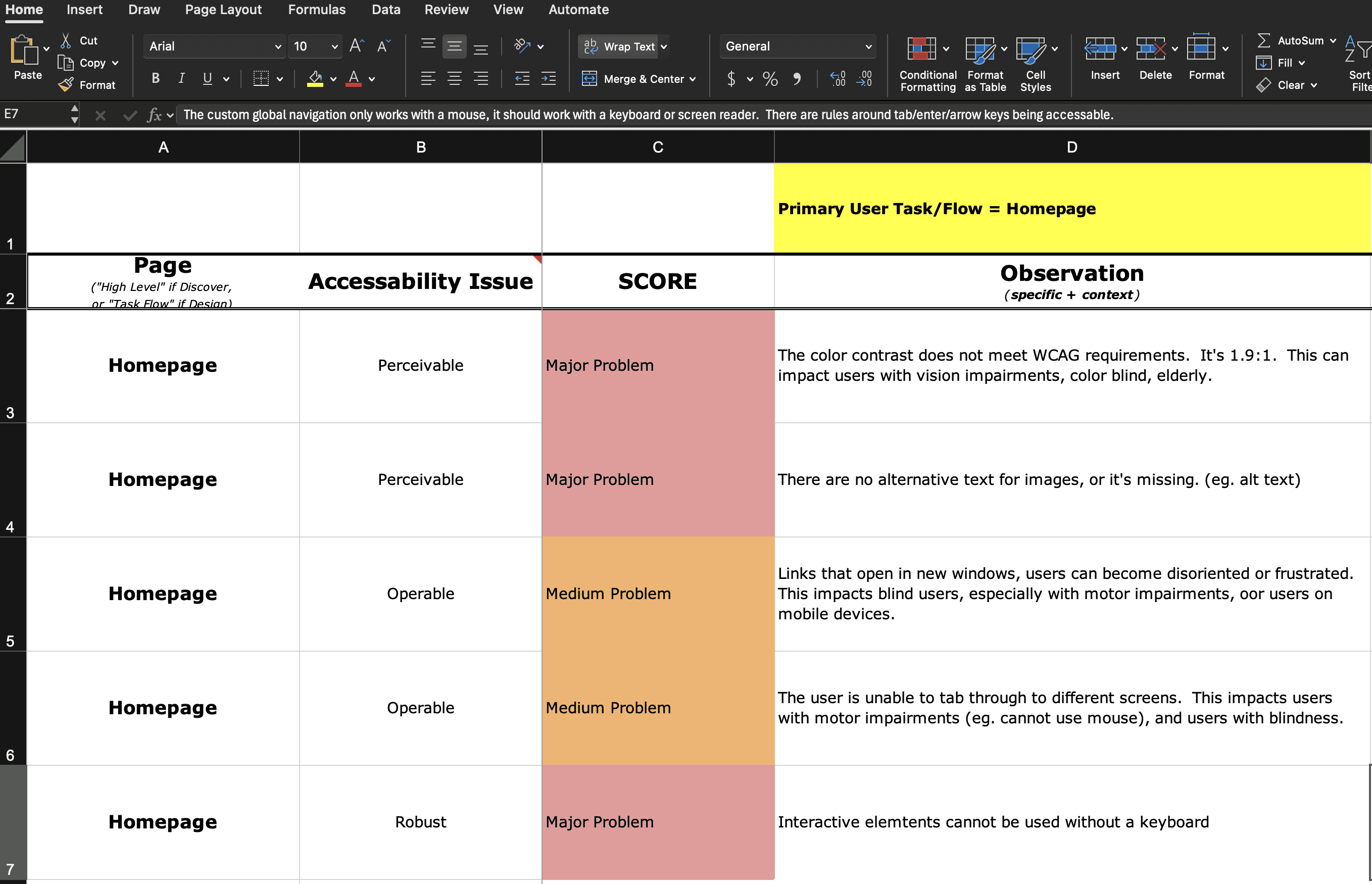
Image 1 Caption

Image 2 Caption
Situation
I was brought in at the end of the website build to perform an accessibility review before launch. The lead designer had completed the primary design work, and some early accessibility considerations had already been incorporated. My role was to assess whether the experience was structurally ready for real-world use, particularly for users with visual impairments and motor limitations..
What Was Really Going On
The surface assumption was that accessibility had been “handled” because it had been discussed earlier in the process. In practice, several issues only become visible when you test systematically and step through the interface the way assistive technologies or keyboard-only users would. In the review document, you can see where screen reader labeling, focus order, contrast ratios, and interactive targets required refinement. The gaps were not dramatic, but they accumulated in ways that could create friction or exclusion. The issue was not negligence. It was the difference between intention and verification.
What Shifted
The shift was from assuming compliance to validating experience. Rather than treating accessibility as a checklist item completed earlier in the project, it became a structured pass focused on how the site would actually function for users navigating without a mouse or without sight. The findings were relayed directly to the lead designer, and adjustments were made with clarity about what problem each change addressed.
What Changed
The site launched with stronger support for screen readers, clearer focus states, improved contrast, and more consistent interaction behavior for users relying on keyboard navigation. The changes were incremental but materially improved usability for specific user groups. Launching with these refinements reduced risk and increased confidence in the product’s readiness.
This Pattern Isn’t New
Accessibility is often addressed conceptually during design and only stress-tested near the end, which is when structural gaps become visible.